
How Can I Make This Right?

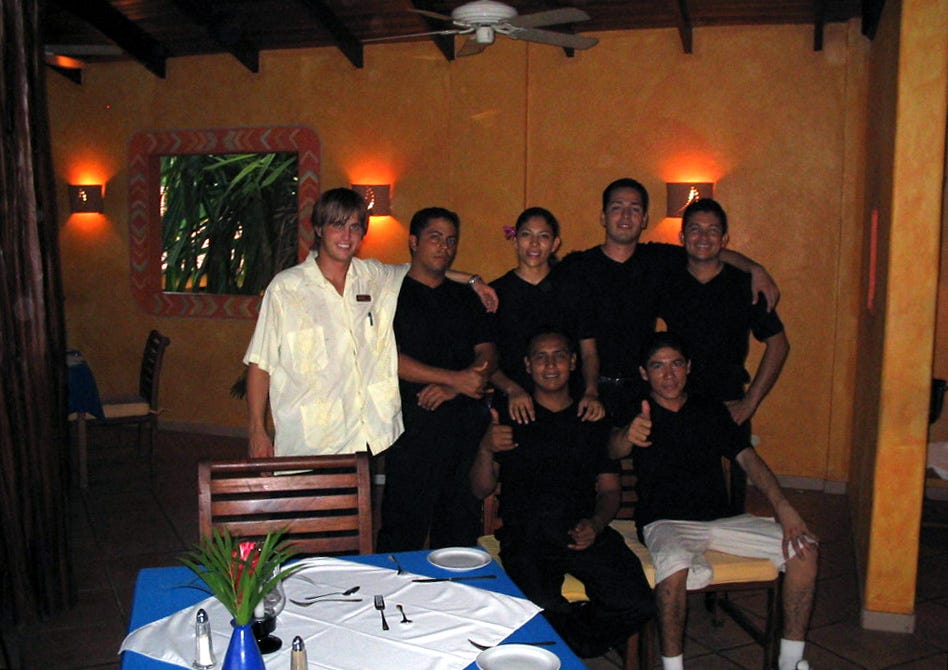
That time I forgot we were wearing black shirts for a special event at the restaurant!
I started traveling through Latin America over 25 years ago, when I was 15. My tan light skin standing out very blatantly. But as soon as I’d open my mouth to speak, I’d be greeted with a smile of surprise, “pero, de dónde eres?” “But, where are you from?” From Argentina, to Costa Rica, to Mexico, local friends of friends would ask me which part of the country I was from. Once I let someone know I was from the States, the reply was usually “pero tu español es perfecto.” “But, your Spanish is perfect.”
Wherever I am in the world, whether I’m invited to a neighbor’s house, a fancy party, or I’m stepping foot on another peoples’ soil, I practice an attitude of reverence — respect, adaptation, assimilation. I’m here because I want to enter into, learn, a new world, be more like my hosts.
The key word when I meet a new local is the “but” — the average American traveler then, and exponentially now, with the conception of Instagram, carries himself with his chest lifted to the sun, elevated by a golden chain held by the hand of none other than the almighty God, Himself. Shoulders pulled back, chin and nose elevated. Completely oblivious to local greetings customs, he walks into a cafe and launches straight into, “I’ll take a cold brew and egg white omelet. Avocado, mushrooms, spinach. And a chocolate almond milk protein shake on the side.” Maybe tacking onto the end a contrived, “grahhh-sea-ahs” in a southern drawl, with a smirk and wink for his friends.
This “mala vibra”, bad vibe, that locals can’t quite put their finger on, is all too familiar for me. It’s what I smelled in the air the day the two white missionaries heard there was another American staying in small town Argentina back in 2001. The harsh sound of English interrupted the gentle lullaby of my afternoon siesta. I opened the wooden doors that kept the sun from my room. I rubbed my eyes as they adjusted to the bright white light. I could barely make out the pale figures dressed in white standing in front of the concrete futbol arena across the street from my local host’s home.
“Hola, buenas tardes,” I greeted them in a groggy tone.
“We’re with the <whatever> church…” they went on…
“Como como?” I interrupted, unwilling to engage in English.
“Ehhh-stah-moohs cone lah eey-glay-sea-uhh…” they started to repeat in the typical Gringo twang.
“Amigos, estoy durmiendo, buena tarde.”, guys…I’m sleeping. I closed the windows.
The irony is the Americans come seeking peace, nature, “pura vida.” But then each one wants his creature comforts — nice cars and roads, swanky beach hotels with air conditioning and pools, sunset lounges with house music, fancy sushi, and organic soap (<- guilty!). And like a frog boiling, converts paradise into yet another American annex, Disney World. That nobody wants.
“Power corrupts, and absolute power corrupts absolutely.” — Lord Byron Acton
In Maxims for Revolutionists, George Bernard Shaw famously proclaims:
“The reasonable man adapts himself to the world: the unreasonable one persists in trying to adapt the world to himself. Therefore all progress depends on the unreasonable man.”
There’s a reasonable argument that this attitude served the Pilgrims well as they escaped religious persecution. But the shadow is all too great to ignore — the unfathomable expense of the Native Americans and Africans.
Progress is indeed a virtue. And so too is adaptation, sustainability. The yang has so massively overpowered the yin in this modern world. I often ask myself, “how can we make this right?”
The answer, I believe, is within — “how can I make this right?” How can I balance the light and the dark, the day and the night, the strength and the gentleness. The domineering shadow of the masculine seems to so completely obliterate any remnant of the feminine; I feel such uncertainty when I look out into the world. And so I start inside, where there is plenty of balance yet to be found…
The easiest place I’ve begun is with my own ocassional pattern of launching into what I need without acknowledging the human I’m engaging with.
And then a bit more complex — a person with relatively much stronger financial means, how do I engage with my community in a healthy way, that helps make all this a little less wrong?
I think the answer lies in my relationship with my little neighbor next door. I’ve become close with him over the last couple of months; let’s call him Carlitos for anonymity. His family is from Nicaragua; his mom came with the kids in search of work. The first time I invited him to join me for a walk on the beach, I sensed shame from him. After some soft encouragement, he agreed to come. As we walked amongst an ocean of white bodies, his head was low, his dark brown skin standing out in the crowd. I kneeled down next to him. I gently lifted his chin, “Carlitos, esta playa es tan tuya como de cualquiera.” “Carlitos, this beach is as much yours as it is anybody else’s.” It was his 8th birthday. His eyes lifted meekly. They opened wider as he took in the lifeguard stand towering over the beach and overlooking the setting sun. As we approached, the tan blonde sitting in the tower turned her gaze towards us. I reached down for Carlitos’ hand.
“Can he come up?” I asked politely.
“Ahhh, unfortunately it’s not allowed…” she smiled, her Australian accent giving her away immediately.
“P-lll-eeeaaasssee”, I pleaded with a big smile, “it’s his birthday today!”
She glanced around to make sure the coast was clear. She looked down and smiled again.
Carlitos climbed up and sat next to her. The look on his face was priceless.
As we walked back down the beach, knowing my Spanish vocabulary has its…mmm…gaps, Carlitos began pointing out different objects to see if I knew the name of each. Every time I was stumped, he’d offer a few different terms to describe it, explaining the subtleties with great enthusiasm, quizzing me as the waves washed over our feet.
“Tu me ayudas a mi, yo te ayudo a ti!” he exclaimed, “you help me, I help you!”
When we got back to our houses, I asked if he wanted “pipa”, cold coconut water. “Si me invita!” he responded, “if you’re offering!” As I unlocked my door, he remained standing on the ground at the edge of the patio. It’s customary in Latin America to not step into another’s home without an express invitation. “Pasa,” I said eagerly, and he skipped across the porch.
Opening the fridge to get the cold coconuts, I saw his eyes light up at the array of fresh fruit and vegetables.
“Quieres fruta?”, I asked, “do you want fruit?”
“Si me invita!”, he glowed.
Yet as I cut into the cold pineapple and prepared his plate, I felt an echo of an old, familiar clinch — scarcity. The feeling was telling me I don’t have enough to share! Even though I literally have orders of magnitude more materially than Carlitos, a thin child of a single immigrant mother who works I can’t count how many jobs and rarely has time to even be home much less care for the kids.
I used to listen to this scarcity, let it be my master, succumb to its stinginess. Or later in life, to not listen to it but to shame myself for feeling it. This time, I did neither. I just noticed it. I looked at Carlitos; he was smiling brightly. I smiled. I offered him the plate.
As I reflected, I realized — hungry, faced with a fridge full of food, asked if he wants some cold fruit in the heat of the day, Carlitos only reply was to humbly, proudly shine his light.
How can I be more like Carlitos?
May we all be more like Carlitos.